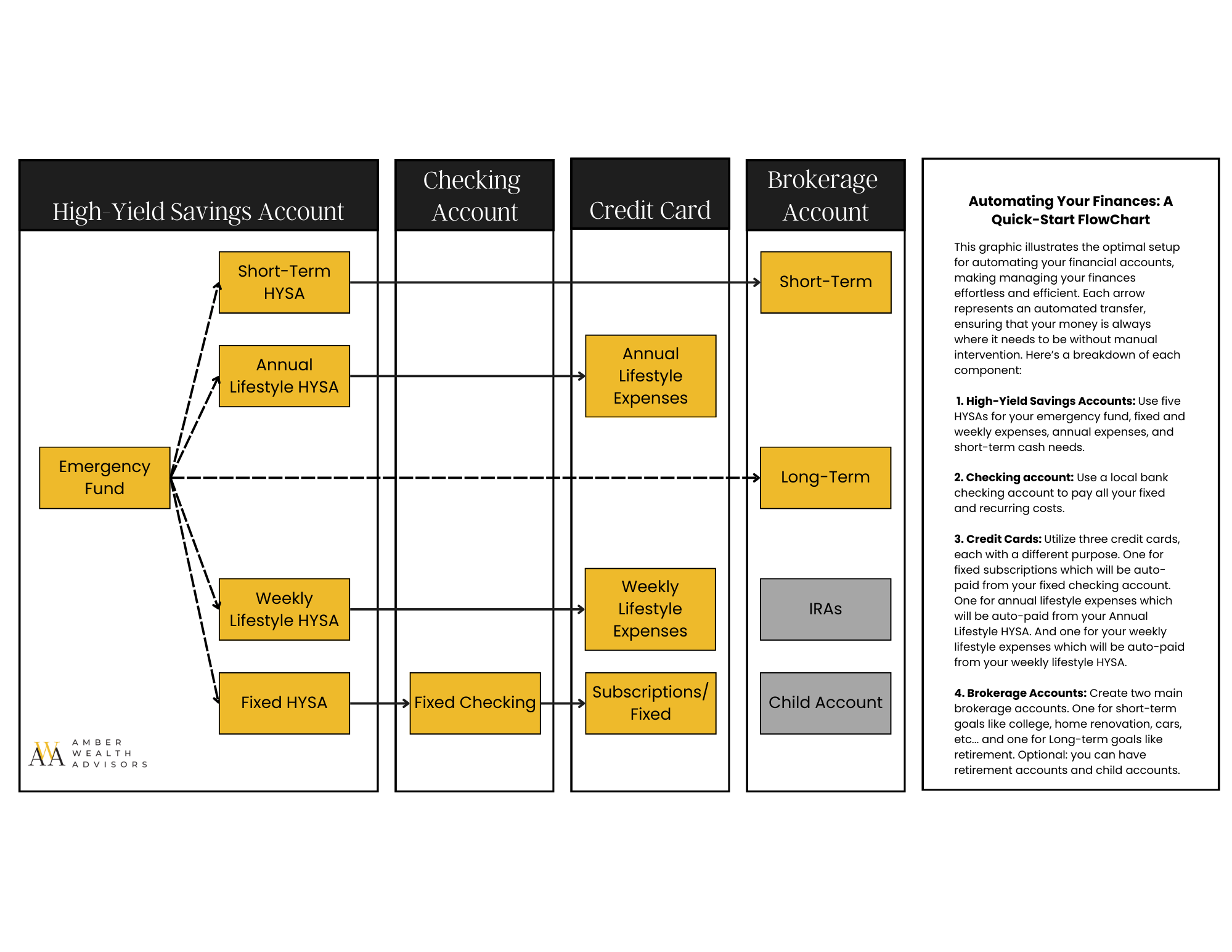
This is the exact account structure I use with high-income couples to run their money without budgeting. It's right below — no form, no gate, no catch.
Read it in 30 seconds
Every arrow is an automated transfer. Once the amounts behind them are right, money moves on its own — you're not deciding anything month to month.
Your emergency fund, plus four buckets: fixed expenses, weekly lifestyle, annual lifestyle, and short-term cash. Separate accounts do the work a budgeting app was never going to do for you.
Where money landsA single local checking account that exists for one job: paying fixed and recurring costs. It isn't where you spend. It's a pass-through.
Where bills clearOne for subscriptions and fixed costs, one for annual lifestyle, one for weekly lifestyle. Each is auto-paid from its matching savings bucket, so the balance is already funded before the statement arrives.
Where money is spentOne for short-term goals — college, a renovation, the next car. One for long-term. Optional: retirement accounts and accounts for the kids.
Where money growsBefore you copy it
Anyone can open five savings accounts in an afternoon. What decides whether this holds up is the set of numbers sitting behind each arrow — and none of those numbers are on the chart, because they're different for every household.
Split it wrong and you drain the weekly account by the 20th — or leave money parked in cash for years that had a better job to do. The percentages that work for a $180k household don't work at $400k.
Most couples misclassify a meaningful share of their spending on the first pass. Anything filed in the wrong bucket resurfaces months later as a surprise you'd already technically paid for.
"Three to six months" is a slogan, not an answer. Two stable W-2 incomes, one income plus variable comp, and self-employment each call for a different number — and a different place to hold it.
Irregular income is what breaks this structure most often. It arrives with no bucket assigned, sits in checking for three weeks, and quietly becomes lifestyle.
Short-term dollars and long-term dollars shouldn't be invested the same way, and account type and tax treatment aren't interchangeable. Two boxes on a chart hide a lot of decisions.
A structure built around today's paycheck doesn't automatically hold after the next raise, the next kid, or the next move. Every one of those is a decision the chart can't make for you.
The architecture is the skeleton. The judgment underneath it is the actual work — and it's what I spend my week writing about.
Common failure points
If bills, groceries, vacation savings, and the new roof all sit in the same balance, no number on the screen means anything. You can't spend confidently because you never know which dollars are already committed.
There is never anything left. This structure works because investing happens on payday, in the same automated motion as the electric bill — not as a decision you make after a month of spending.
Insurance premiums, property taxes, holidays, birthdays, travel. These aren't emergencies — they're scheduled. Funding them monthly is the single change that makes most couples stop feeling behind.
The weekly system
The chart gives you the structure. The email works through the decisions underneath it — one short email a week, no fluff.
One email a week. Unsubscribe anytime. I never sell or share your information.

Who put this together
I spent more than two decades in corporate finance and tax. When my wife and I finally reached the income I'd worked toward, I was surprised to find that making more money didn't solve it — every raise grew our lifestyle, not our wealth. We weren't irresponsible. We were just still making manual money decisions every week, with no system pointing our income anywhere.
So I stopped hunting for another budget and built a structure instead. That structure is the chart above. Now I help high-earning couples build the same thing for their households.